Planets & Biochemistry
Unlike in many other role-playing games, Striker will have your characters touch down onto many alien planets. It’s a bit unfortunate that the film and television industry has, on the whole, failed to really represent alien planets all that well, and just what kind of environments you would expect. This section aims to fix that. This will hopefully provide some help in visualising what alien planets might look like.
In Striker, there are literally billions of stars in the region known as Guild Space. Eight out of every ten of those stars has at least have one planet orbiting them, and most have many planets.
Of stars with planets, pretty much all of them have the precursors of life, such as amino acids and proteins, either in the molecular clouds near them, or locked up in the balls of ice that make out the outer belts of the systems they are in. However beyond these promising precursors, most planets are biologically dead.
Barren Rocky Planets
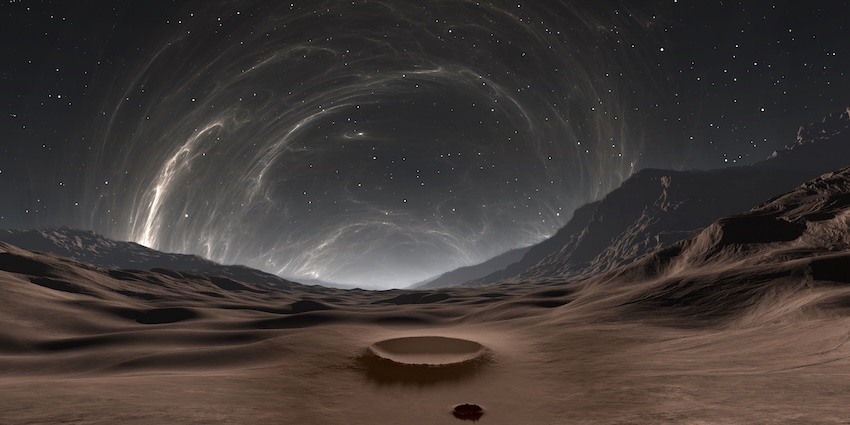
Terrestrial planets, those like Earth or Mars, will often not have life, because they did not retain an atmosphere. They end up spending most of their existence looking like the moon or Mercury. The above image shows a typical example. You can see the corona of the star that's about to rise. As a tip, don't stay and watch this: you'll die, but at least it’ll be quick.
Atmosphere loss usually happens because the planet lost its geomagnetic field at some stage in the past. The loss of the magnetic field, usually happens, because the planet is really small like Mars, or so close to its star that it becomes tidally locked to the star and so stopped its rapid spinning.
Thin Atmosphere Planets
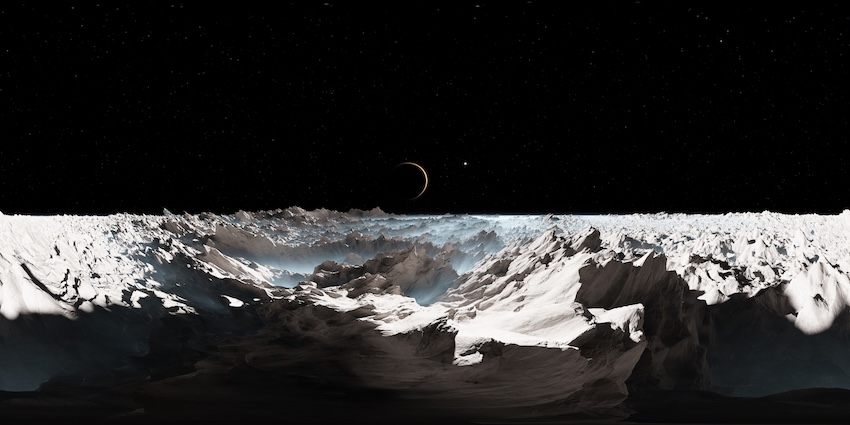
When a terrestrial planet is a bit further from its star, the loss of atmosphere is very gradual, and you often get planets that are in this gradual transition. Mars is a typical example of one of those: its mass at only 10% of earth, has meant that its relative loss of internal heat has happened much faster than on Earth (where it's negligible). The loss of internal heat has shut down the internal dynamo that produced its geomagnetic field, and so there is nothing to prevent the solar wind from eroding the atmosphere. Many of these planets have atmospheres that are so thin that you can easily see stars in the daytime.
Ice Planets
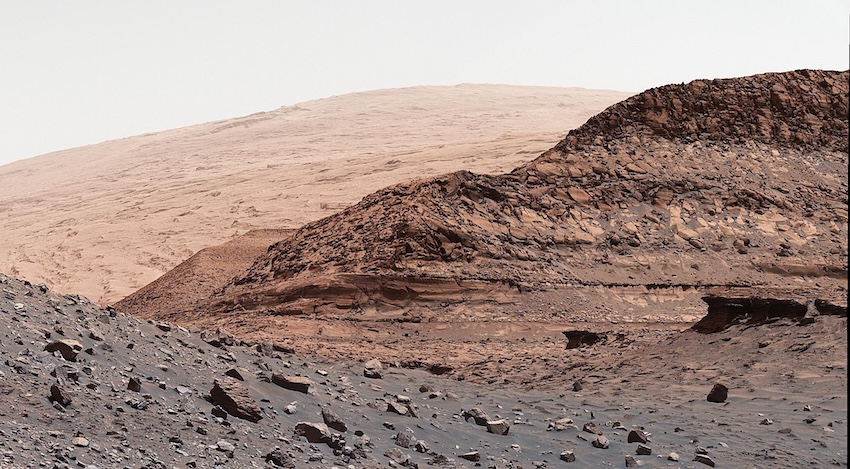
Ice planets condense further out in the system, beyond the so-called snow-line. They have icy surfaces, or surfaces covered in dust or residues. Most of these exist as moons orbiting gas giants, but they can reach planetary masses, when orbiting very large gas giants or brown dwarfs.
Microbial Life
Despite the inhospitibility of the above planets, many of them can still have microbial life, either on the surface in well protected places (usually also requiring a bit of atmosphere) or locked up just below the surface of rocks. This is usually in association with the liquid phase of the life's solvent (for Earth: that solvent is water).
Biosphere Planets
Going from this to more complex life, however is a big step change. Only about 1 in 100 stars manage to get a planet that has anything more complex than some bacteria on it. This will normally manifest in the main solvent on the planet, and this is where we start going into the biochemistries of biosphere planets.
The Water Biochemistry
The main solvent on earth is water, so we call it a water biochemistry. Plenty of planets with life have water biochemistries, it's not the most common biochemistry, but it does come second.
Aside from microbial life, plant-like life is always the most common and obvious. It may look very different, and be composed of nothing similar to the DNA of Earth, but chlorophyll is a surprisingly common solution to the photochemistry problem. Another common solution are the photochemistris that produce red plants.
Humans, clavians, cephenes and freens are all water-based life, and share this biochemistry. The freen home world, however looks quite different to the others in having a thick atmosphere and large surface area, making it look extremely murky.
Phytacles (pictured below) has a similar average temperature to Earth, but experiences much larger swings. It also has an atmosphere two and a half times thicker, a planetary surface area of nearly 5 times greater and 2 times its gravity. Phytacles is a super earth weighing in at 8.4 Earth masses.
The high mass, high surface area and surprisingly low gravity of Phytacles highlights an interesting fact about terrestrial planets, their gravities don’t go up with mass as much as you’d think. The reason for this is that terrestrial planets are composed of solids and liquids, which are both incompressible forms of matter, so they do not increase greatly in density with size. If this matter can’t be compressed much, then diameters and surface areas must increase instead. The large mass also also means that phytacles is more volcanically active.
The Ammonia Biochemistry
In terms of bulk chemicals, the water biochemistry would be the most common, however because most stars are smaller and colder than the sun, most viable planets have thicker atmospheres and are generally colder, making the ammonia biochemistry the dominant type.
About half of all life-bearing planets are based on ammonia as the solvent. The ronites belong to this biochemistry. To us these planets are coloured black and brown. The oceans are brown with hydrocarbons and the plant life tends to be black. Their atmospheres can vary a lot, but average on about twice the density of earth’s atmosphere.
They are very cold compared to life-bearing planets with a water biochemistry, with climates between -100ºC and -45ºC.
Because the main solvent is ammonia, you get ammonia rain, ammonia oceans and ammonia ice caps. The atmospheres tend to be mostly nitrogen and oxygen, with something like 5% ammonia and trace amounts of carbon dioxide. Although this sounds like air, the ammonia in the atmosphere means that it would burn out a human’s lungs.
Some plants on an ammonia planet still use photosynthesis, but a large percentage use chemosynthesis (this is what funguses on Earth use). In either process, plants tend to use ammonia and carbon dioxide, and produce methylamine, nitrogen and oxygen. Just like on earth, animals on an ammonia planet inhale oxygen and exhale carbon dioxide. Also while Earth has a carbon cycle, ammonia planets use the ammonia cycle, their solvent, directly.
The ronite home world of Xara’an (in the Elkowan system) and their most famous adoptive home world Y’gly’ron (in the Orgleron system) are both large ammonia planets. While they, like Phytacles, would qualify as super-earths, they are not nearly as big. Both are on the order of 2.3 earth masses, have twice the surface area of earth and 1.1 times its gravity.
So you can stand on the surface of either of these planets and have nothing but a rebreathing filter to keep the ammonia out of your eyes, nose and mouth, and be wrapped up in some serious woolies. The cold will get to you first, so you’d better be back in you habitat in a couple of hours or so. Definitely don’t eat the food, it’ll be like swallowing a bottle of vinegar, only worse.
On Y’gly’ron it’s always raining ammonia, its the frigid version of peaty bogs, swamps and marshlands. Locals often rejoice at suddenly planting feet on dry, solid ground.
Ronites naturally see this as the very paragon of beauty, and find most other planets to be untastefully gaudy, and too damned bright. Xara’an, on the other hand, is a desert world.
Both Xara’an and Y’gly’ron orbit smaller K-type stars (like Phytaclys), yet they are about the same distance as Earth is from the Sun. So the thick atmosphere and weak stellar input, make both planets pretty dim to those with lightsense. This is one of the reasons ronites evolved without having eyes. The powerful magnetic fields of both these planets, providing a much better visual sense, through magnetosense.
The Methane Biochemistry
The next most common biochemistry (about 1 in 10 life-bearing planets), is the methane biochemistry. This is potentially, the biochemistry of Saturn’s moon Titan.
Methane planets are extremely cold, the central life-bearing temperatures are around -180ºC. These temperatures are only possible beyond the snowline of stars. The conditions are most commonly met on planets where the accretion of primordial gases was interrupted, and they remained ice planets (rather than turning into gas or ice giants). However very large moons, typically encircling large gas giants or brown dwarfs, can produce these conditions as well.
Thick atmospheres of nitrogen, oxygen and various hydrocarbons form, so the world appears hazy and brown, and outwardly, rather like an ammonia planet. The similar appearance belies the differing biochemistries at work. There is nowhere near enough light for photosynthesis to happen, so all plant-life would rely on chemosynthesis (like funguses on Earth). They use methane and nitric oxide to produce methanol, nitrogen and oxygen. Animal life then breathes the oxygen and produces nitric oxide.
The Sulphur Biochemistry
So we have done the common biochemistries: now for the really rare ones. The first one of these to visit is the sulphur biochemistry, partly because it is the most common of the rare ones, but also because this is the biochemistry of the thots.
The sulphur biochemistry occurs for two reasons:
- the abundance of sulphur is high, compared to oxygen, and
- the average temperatures are such that water exists mostly as a gas and would tend to boil away into space over time.
The temperatures on the surface would average 40ºC hotter than on Earth (an average day on a sulphur planet would be hotter than the hottest day recorded on Earth). Yellows would dominate the ground on a sulphur planet, but they skies would remain blue, broken by yellowish clouds. As long as sulphuric acid is plentiful, the sulphur-rich plant-life would be vigorous and abundant, getting a lot of energy through photosynthesis.
For humans it would be unbearably bright. The thots, of course, see this as an unparalleled paradise of wondrous beauty. They also think that our trees are a bit puny as well: mere shrubs compared to the 300-metre high specimens they're familiar with.
The Phosphorus Biochemistry
Now, to an even rarer type: the phosphorous biochemistry. The phosphorous biochemistry comes about because a planet that has a relatively high phosphorous content (relative to oxygen) gets positioned like Venus, and enters a runaway greenhouse effect. On a phosphorous planet, everything is white. This comes about as phosphorous hangs in the air, forming a white mist and coating everything.
The Chlorine Biochemistry
Now, finally to the rarest type known: the chlorine biochemistry.
Only 1 in every 10,000 life-bearing planets are of this biochemistry. The main reason for its rarity is that chlorine is much less common as an element in the universe then either sulphur or phosphorus, and certainly way rarer than oxygen and nitrogen. Therefore, having it dominate the crust of a planet over these other elements almost never happens.
It is, however, the only path for a carbon planet (a planet where carbon dominates over silicone on the crust) to get life on it. The atmosphere of a chlorine planet contains a lot of chlorine gas, and microbes in the oceans of muriatic acid release chlorine gas as well.
Sophonts And Biochemistry
In the listings for various sophonts, you can see that some of the sophonts have a differing biochemistry to that of humans. Those with the most radically different biochemistries are ronites and thots, as these evolved under ammonia and sulphur biochemistries, respectively. Although cephenes and freens share the water biochemistry of humans, they have some important differences.