Space
Most creatures are accustomed to life within an atmosphere on a planet. Space, on the other hand, is entirely different. The distance scales are enormous and the features of space include stars, planets, interstellar dust, molecular clouds and plasma fields. As a player of the game of Striker, you will likely not be familiar with all of these, and in particular, familiar with how they work, or the dangers they present.
Stars
Stars are the most common feature, and the one most familiar to the reader. Stars come in many different forms, but nearly all major properties are determined by mass and age. Our star, the sun, is larger and hotter than average. Its mass and age (and therefore the colour it radiates) give it a spectral type of G, or sometimes called a yellow dwarf star. Its age (about 5 billion years) places it in the main sequence - an evolutionary stage stars spend the majority of their life in. The full set of main sequence spectral types are listed below:
Spectral Type O
15-150 solar masses, 50K to 100K solar luminosities. Very rare, super hot and short lived and generally very dangerous. 10(field,heat) and 10(field,rad) at 1 AU.
Spectral Type B
3-12 solar masses, 100 to 20K solar luminosities. Also very hot, but more common than the above, these are like beacons in the skies. 5(field,heat) and 5(field,rad) at 1 AU.
Spectral Type A
1.5 - 2 solar masses, 7 to 22 solar luminosities. Still much hotter than the sun, but are more stable. Some cultures build space habitats around them. 3(field,heat) and 3(field,rad) at 1 AU.
Spectral Type F
1.1 - 1.5 solar masses, 1.5 to 5 solar luminosities. These are common enough to have a few within any stretch of 100 stars. Some have colonies, but there is an instability strip through the middle of this type, than can make some members very eruptive. 2(field,heat) and 2(field,rad) at 1 AU.
Spectral Type G
0.9 - 1.1 solar masses, 0.7 to 1.3 solar luminosities. Yellow dwarf. Stable and long lived, these are the hottest stars that have planets where live can evolve. 1(field,heat) and 1(field,rad) at 1 AU.
Spectral Type K
0.5 - 0.8 solar masses, 0.2 to 0.6 solar luminosities. Orange dwarf. Cooler than our sun and far more numerous. These stars are generally the best candidates for developing life on one or more of their planets. 1(field,heat) and 1(field,rad) at 0.5 AU.
Spectral Type M
0.3-0.5 solar masses, 0.01 to 0.1 solar luminosities. Red dwarf. The most common spectral type in the universe. Most stars are of this type. These live for a very long time, and can evolve life, however many are flare stars, and can be a challenge for indigenous life and colonies alike. 1(field,heat) and 1(field,rad) at 0.1 AU. During flares, it can become 2(field,rad) or 3(field,rad) at the same distance.
Spectral Type L
0.1 - 0.3 solar masses, 0.01 to 0.1 solar luminosities. Bright brown dwarf. These are even more common than red dwarves, however they are only marginally stars. These are two dim to develop life on planets orbiting them. Any activity around a brown dwarf is usually mining. Although a few rare habitats orbit close to the star itself.
Spectral Type T
0.04 - 0.1 solar masses, 0.0001 to 0.0002 solar luminosities. Mid brown dwarf. A cooler category, usually because of low mass and age.
Spectral Type Y
less than 0.04 solar masses, less than 0.0002 solar luminosities. Dim brown dwarf. A cooler category still. The field conditions of heat and radiation diminish with distance. At 2 AU, for example, all ratings are halved.
Giant & Subgiant Stars
As stars age, they eventually pass out of the main sequence and pass through one or more giant phases. These giant phases are short lived so stars that are currently in the giant phase are comparatively rare. Although, before going into the giant phase there is a relatively longer-lived sub- giant phase, and there are many more of these.
Degenerate Stars
After a star has passed through the giant phase, they generally explode and leave behind a remnant. There are four main types of remnants, of them the white dwarf is easily the most common, with the other three being exceptionally rare.
White dwarf
By far the most common degenerate (maybe 8 in every hundred stars). These are small (around the size of Earth), dim, and exceptionally dense (if any of your dies were made of white dwarf, it would weigh about the same as your car). Any life that was in the system would have been extinguished during the giant phase. Colonies are often set up in these systems because of them often having rich metal deposits, among the surviving planets.
Pulsar
This is the remnant left behind when stars weighing more than 10 times the mass of the sun, explode at the end of their giant phase. The explosion is so powerful, even scientists get excited and call it a supernova. The pulsar is so much denser than a white dwarf, with your d6 now weighing the same as 15,000 cruise ships, or say Mt Everest. The original star’s rotation and magnetic fields are sped up, creating a flash of light radiating out of the magnetic poles, rotating thousands of times a second. As pulsars age, their rotation reduces. This slowing down happens quickly when the magnetic fields are very strong.
Neutron star
These are pulsars that no longer flash. This happens after 100 to 500 million years. As there is no flashing at all, neutron stars are often hard to spot. However they do have a significant gravity field.
Stellar Black Hole
This is the remnant left behind when a star 50 to 130 solar masses, explodes in a hypernova. A stellar black hole is usually between 4 and 14 solar masses and about 15 to 20 kilometres in diameter. There are three stellar black holes in Guild Space.
Clouds
Space is not entirely empty, in any metre cubed there are always at least a few ions, atoms and/or molecules floating around. This non-emptiness of space is referred to as the interstellar medium. There are various temperatures and compositions of this, but more important in the game is when this gets concentrated in some areas.
Molecular Clouds
These are clouds of gas molecules of primarily hydrogen that have become concentrated as a result of the turbulence of the interstellar medium. Although they appear as clouds in space, often blocking the stars behind them, they are still incredibly tenuous being trillions of times less dense than the Earth’s atmosphere at sea level. These clouds are often hundreds and some are even thousands of light-years across. The denser areas of these clouds usually become stellar nurseries at some point. Molecular clouds pose few hazards for space travellers, but can limit particularly high procession speeds and degrade orbits due to friction.
Ionised Clouds
These clouds have been heated and ionised by bright stars or a recent supernova. The ionisation creates a field that will do electric, heat and radiation damage to an unprotected creature. Generally the field will range from 1(field,elec), 1(field,heat) and 1(field,rad) up to 4(field,elec), 4(field,heat) and 4(field,rad).
The existence of a the electric rating component can play havoc with striker shielding, which is mostly electromagnetic. The effect is either that the shields act like brakes dampening evasive manoeuvring, or they are momentarily nullified. In either case, strikers can become sitting ducks in ionised clouds.
Interstellar Space
The presence of cosmic radiation, means that all of interstellar space is at least a 1(field,rad) environment.
Distance in Space
The distances in space are so vast that the longest unit we have talked about so far, the kilometre (km), is not adequate. In space, we need two new units: the astronomical unit (au) and the light-year (ly).
Astronomical unit (au)
This is the distance between the Earth and the Sun. It is just under 150 million km, and 0.0016 % of a light-year. This is the unit of measurement used within planetary systems.
Light-year (ly)
This is the distance light travels in a year. It is just over 10 trillion km and 63,000 au. This is the unit of measurement we use for interstellar distances.
Space Travel
Because space is in a near-vacuum (no atmosphere), there is no drag, and so the top speed you may move at is not about how much thrust you can maintain. A simple trip in space is mostly about:
- accelerating to a speed at the start,
- shutting down the engines and letting the ship drift along at that speed
- switching on the engines, but this time, in reverse, and decelerating, until you come to a stop at your destination.
Therefore, your ability to accelerate, and the amount of time you can keep accelerating, governs your top speed.
If you want to change direction, this also involves switching on the engines until the turn is completed.
Your ship’s vacuum speed is therefore, really about the strength of its acceleration, and how quickly you can switch it on or off. To keep things relatively simple, we say that any ship capable of 1(fly,vacuum) can cover 1(au) per hour. This includes the initial acceleration, drift and final deceleration phases of the journey. In 1 atmosphere of pressure, this equates to the following fly characteristics 12(fly), 125(fly,m/s), 450(fly,km/h), assuming zero aerodynamics.
Given that interplanetary distances in the inner parts of any star system are on the order of 0.25(au) to about 5(au), you can expect to travel between any planets on the order of 15 minutes to 5 hours, at 1(fly,vacuum), depending on where they are all on their various orbits.
In the outer parts of star systems, the distances range:
- from 5(au) to 30(au), for jovian planets
- from 30(au) to 100(au), for the Kuiper belt
- from 2,000(au) to 5,000(au) for the main part of the Oort cloud.
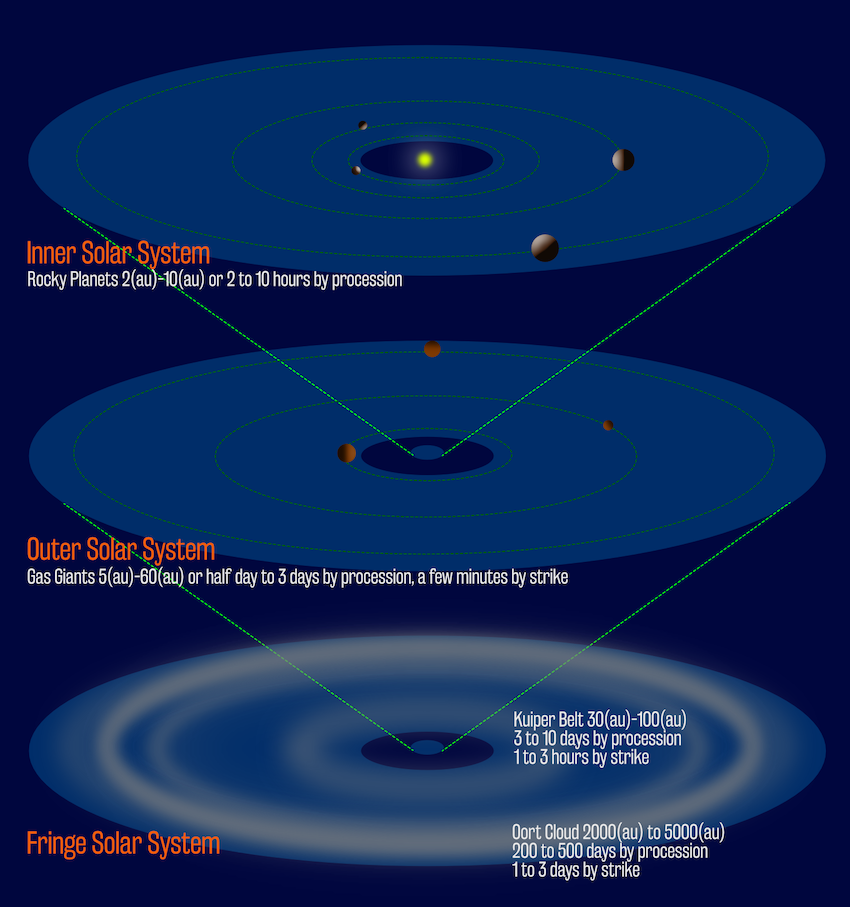
Some of the fastest interplanetary space travel ranges out to about 10(fly,vacuum), and a few exceptional cases go beyond this. For the purposes of interplanetary travel, no ship can exceed 15(fly,vacuum). To do so would mean travelling near to or beyond the speed of light, which is impossible.
Even at 10(fly,vacuum) you will still take roughly 1.5 hours for trips around the jovian planets and around 14 days to get around areas of the oort cloud. Also, if you want to cross 1ly using 10(fly,vacuum), you’ll need roughly 250 days or two-thirds of a year.
As you will see in the next section, with 1(fly,ethereal) you can cover 1ly in just 10 days, making 1(fly,ethereal) equal to about 250(fly,vacuum) or 16 times the speed of light.
Interstellar Travel
Interstellar travel usually requires a striker. Strikers are unique amongst constructs in having a fly,ethereal speed. Unlike most other vehicle constructs, strikers require a navigator to use their ethereal speed.
The number in front of fly,ethereal tells us how many light- years a striker can travel in a 10-day period in well-mapped regions of space. In poorly mapped regions, the move mode is seminatural and the period doubles to 20 days, and in unmapped regions, the move mode is unnatural and the period becomes 40 days.
As a matter of detail, strikers do not travel in physical space, but in a between-space most commonly known as the ethereal (although terms like hyperspace and subspace are also used). This means that the light-years travelled are only an approximation to the physical light-years seen in what is termed corporeal space. The ethereal speed is actually the speed in the ethereal, which is technically bathymetric or scersic speed, and may be more or less than the light-years distance travelled between the dive and the surfacing in a strike.
If we take a strike between Sol (our sun) and Proxima Centauri (our nearest stellar neighbour). This is 4.2 light-years, which approximates to a scersic distance of 4 in a well-mapped region of space. In a striker capable of 2(fly,ethereal), this trip will take 20 days, from the dive near Sol to the surfacing near Proxima Centauri.
see the Psikinesis and Telepathy skills for details of making strike rolls.